GPS 10 MHz Frequency Reference - FS740
FS740
12 digit/s frequency counter Source output — sine, square, triangle, IRIG-B Built-in distribution amplifiers Ethernet and RS-232 interfaces GPS/GNSS disciplined 10 MHz
广西科米瑞实验仪器设备有限公司提供 Stanford Research Systems FS740 产品资料、选型咨询、供货报价和售后服务支持,价格面议。
← 返回产品列表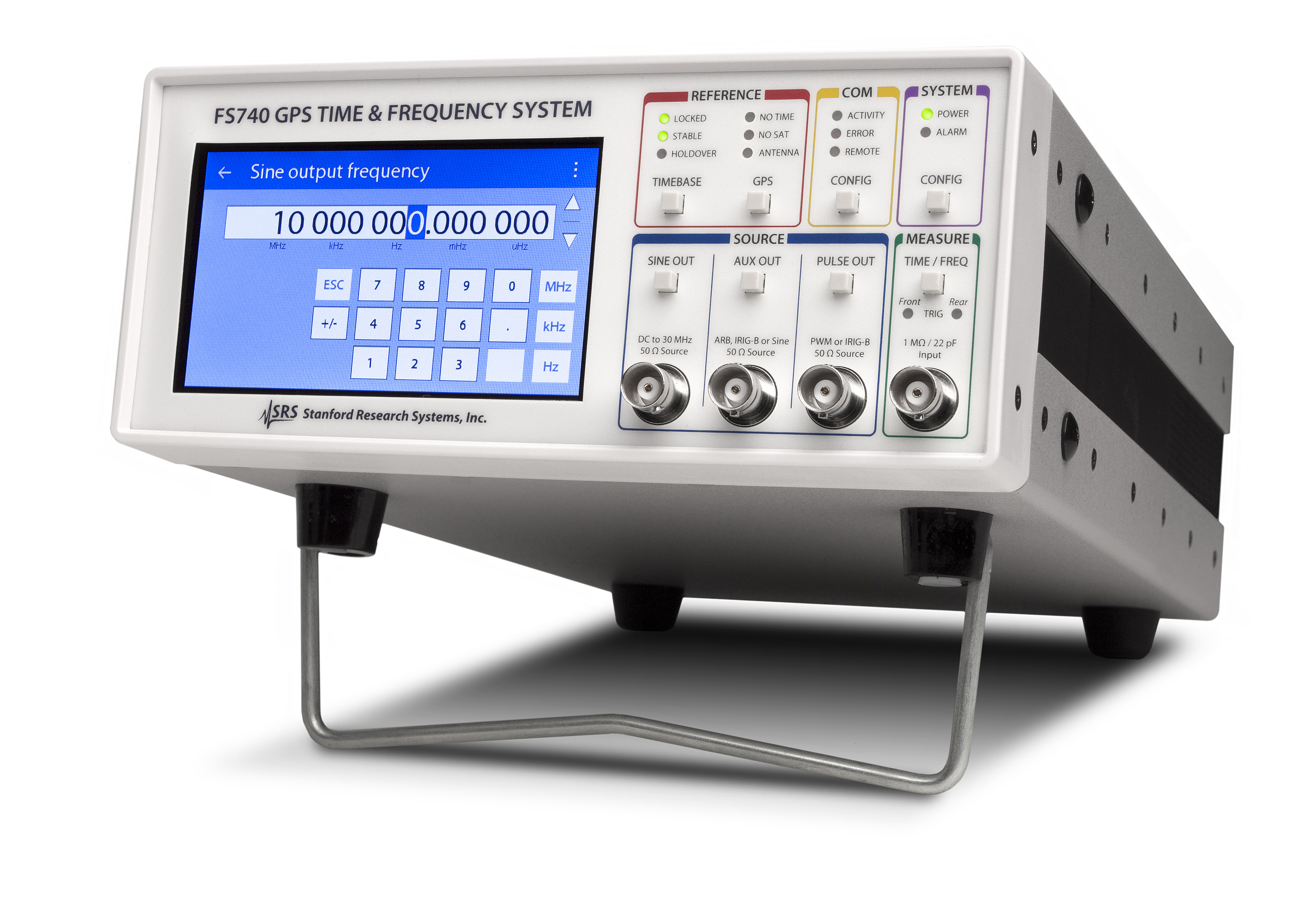
说明
12 digit/s frequency counter Source output — sine, square, triangle, IRIG-B Built-in distribution amplifiers Ethernet and RS-232 interfaces GPS/GNSS disciplined 10 MHz OCXO or Rubidium timebase Time tag events to UTC or GPS FS740 GNSS/GPS 10 MHz Reference The FS740 GPS Time and Frequency System provides a 10 MHz frequency reference with a long-term stability of better than 1 × 10 -13 . A built-in receiver tracks any of the four major GNSS constellations: GPS, GLONASS, BEIDOU, or GALILEO. The instrument can also time tag external events with respect to UTC or GPS and measure the frequency of user inputs. The instrument has DDS synthesized frequency outputs, adjustable rate (and width) pulse outputs, and an AUX output for arbitrary waveforms including an IRIG-B timecode output. ... click for FS740 Tech Support Single Rack Mount Drawing Double Rack Mount Drawing 3D Step File FS740 Volatility Statement FS752 GPS/GNSS DO FS725 Rb Frequency Standard PRS10 Rb Oscillator FS735 Distribution Amplifier SG380 Signal Generator Single Rack Mnt. Dwg. Double Rack Mnt. Dwg. 3D Step File FS740 Volatility Statement FS752 GPS/GNSS DO FS725 Rb Freq. Std. PRS10 Rb Clock FS735 Distr. Amp. SG380 RF Sig. Gen. FS740 10 MHz GPS Frequency Reference X FS740 Phase Noise FS740 The standard timebase provides 1 × 10 -9 short-term frequency stability and phase noise of less than -105 dBc/Hz (10 Hz offset) . An optional OCXO (ovenized crystal oscillator) timebase provides 1 × 10 -11 short-term frequency stability and phase noise of less than 130 dBc/Hz (10 Hz offset) . An optional rubidium timebase provides 1 × 10 -12 short-term frequency stability, phase noise of less than -130 dBc/Hz (10 Hz offset) , and a long-term holdover (lost GNSS signal) of better than 1 μs/day. Both optional timebases (OCXO or rubidium) provide a dramatic improvement in the holdover characteristics, a 30 dB reduction in the phase noise, and a tenfold reduction in the TDEV (rms timing deviation). There are some users who would not need this performance improvement. For example, users who only need time tags with 1 µs accuracy or frequency measurements with 1 × 10 -8 accuracy could use the standard timebase. The FS740 provides bias for a remote active GNSS antenna. The unit's GNSS receiver tracks all satellites in view, automatically surveys and fixes its position, then uses all received signals to optimize its timing solution. The FS740 time-tags the 1 pps output from the receiver, corrects the result for the receiver's sawtooth error, then phase locks the timebase to the GNSS 1 pps. The TDEV between two instruments is a few nanoseconds. If the GNSS signal is lost, the timebase is left at the last locked frequency value. The timebase will age or drift in frequency by up to ±2 ppm (for the standard timebase), ±0.05 ppm/year and ±0.002 ppm (0 to 45 ⁰C) for the OCXO, and ±0.001 ppm/year and ±0.0001 ppm (0 to 45 ⁰C) for the rubidium timebase. You may choose to purchase a GNSS antenna from SRS, or a third party, or use an existing GNSS antenna at your facility. SRS timing receivers require a net gain (after cable losses) of +20 dBi to +32 dBi, which is a very common level from a variety of available active antennas and typical cable lengths. The antenna input to SRS timing receivers have a female BNC connector, provide +5 V bias, and have a 50 Ω input impedance. X FS740 Statistical Analysis FS740 FS740 Statistical Analysis SRS offers two antenna solutions, both of which have LNAs. All systems components have a 50 Ω characteristic impedance. For antenna details click here . Graphical User Interface A graphical user interface allows the user to configure the instrument and see the results of time and frequency measurements. The instrument can be configured in one of three modes: There are two user inputs (one on the front, one on the rear panel) for frequency and time tag events. The inputs have adjustable thresholds and slopes. Frequencies are measured with a precision of 1 × 10 -11 in 1 s, 1 × 10 -12 in 10 s, and 1 × 10 -13 in 100 s. Time tags are reported with 1 ps resolution which is comparable to the short-term stability of the OCXO and rubidium timebases. Time tags will have an error of about 10 ns rms with respect to UTC or GPS time. The FS740 has a rear-panel low phase noise (-130 dBc/Hz at 10 Hz offset) 10 MHz sine output with an amplitude of 1 Vrms. Up to 15 additional copies of the 10 MHz output are available via optional rear-panel outputs . X FS740 Locked to GPS FS740 The FS740 has front-panel and rear-panel SINE outputs which provide sine outputs from 1 μHz to 30.1 MHz with 1 μHz resolution, or a fixed 100 MHz, with adjustable amplitude from 100 mV to 1.2 Vrms. Up to 15 additional copies of the SINE outputs are available via optional rear-panel outputs . The FS740 has front-panel and rear-panel PULSE outputs which can provide low jitter (<50 ps rms) pulses from 1 mHz to 25 MHz. The PULSE outputs have adjustable phase with respect to UTC and the pulse width can be set as narrow as 5 ns, or as wide as the entire pulse period minus 5 ns, with 10 ps resolution. Up to 15 additional copies of the PULSE outputs are available via optional rear-panel outputs . The FS740 has front-panel and rear-panel AUX outputs which can generate standard or arbitrary waveforms (sine, ramp, triangle, etc.) The AUX output can also provide an IRIG-B timecode output. Both width coded pulses and amplitude modulated sine waves (with carrier frequencies from 100 Hz to 1 MHz) are available for the IRIG-B outputs . Up to 15 additional copies of the AUX output are available via optional rear-panel outputs . A rear-panel alarm relay is set if power is lost or under user defined conditions including: timebase fault, loss of GNSS reception, or any failure to maintain phase lock between the timebase and the GNSS signal. The relay has both normally open and closed outputs. X 1 s, 10 s, 100 s, 1000 s Allan Variance FS740 1 s, 10 s, 100 s, 1000 s Allan Variance Optional distribution amplifiers, each providing five additional rear-panel outputs for the 10 MHz, SINE, PULSE, AUX or IRIG-B outputs, can be installed. Up to three distribution amplifiers can be installed and configured from the front panel. Each output has its own driver which provides high isolation between outputs.
相关产品
提交需求
请填写必填信息,我们将在工作日尽快回复。