Lock In Amplifiers - SR2124
SR2124
Low noise current and voltage inputs Harmonic detection (f, 2f, or 3f) Selectable input filtering Low noise, all analog design No digital interference
广西科米瑞实验仪器设备有限公司提供 Stanford Research Systems SR2124 产品资料、选型咨询、供货报价和售后服务支持,价格面议。
← 返回产品列表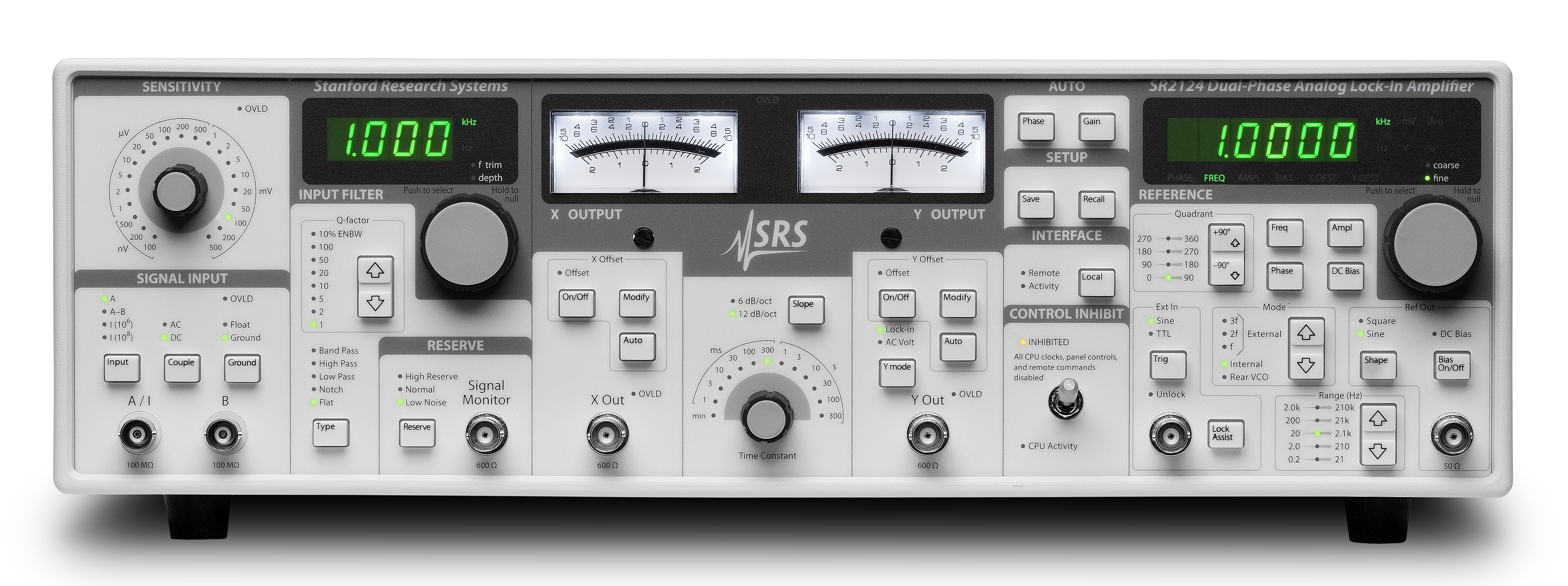
说明
Low noise current and voltage inputs Harmonic detection (f, 2f, or 3f) Selectable input filtering Low noise, all analog design No digital interference 0.2 Hz to 200 kHz range Low noise current & voltage inputs 0.2 Hz to 200 kHz measurement range SR2124 Lock-In Amplifier Recognizing that one size shouldn't have to fit all, SRS is proud to introduce the SR2124 Dual-Phase Analog Lock-In Amplifier . Inspired by the best of an earlier generation's lock-ins , but availing itself of today's low-noise analog components and design methodologies, the SR2124 is a tour de force in low-noise, high-performance analog instrumentation. ... click for SR2124 Tech Support Lock-In Basics Signal Enhancement Rack Mount Kit Drawing SR865A Lock-In Amplifier SR860 Lock-In Amplifier Optical Choppers CS580 Current Source DC205 Voltage Source SRS Preamplifiers SX199 Interface Controller Lock-In Basics Signal Enhancement Rack Mount Kit Dwg. SR865A Lock-In Amp. SR860 Lock-In Amp. Optical Choppers CS580 Current Source DC205 Voltage Source SRS Preamplifiers SX199 Interface Controller SR2124 Analog Lock-In Amplifier For over a half century, the lock-in amplifier has been the instrument of choice for measuring small AC signals in the presence of noise. Early instruments were designed with analog electronics, multi-gang mechanical switches, needle indicators, etc., and measurements were often monitored with chart recorders. Microprocessor based designs emerged in the 1980s, and by the early 1990s even the lock-in's analog demodulators were replaced by high-resolution ADCs and digital signal processors (DSP). Remote computer control, digital readouts and user-friendly front panels all resulted. The capabilities of the modern DSP lock-in amplifier in stability, dynamic reserve, and flexibility were revolutionary, making it a mainstay for researchers and engineers across multiple fields. But in moving forward, something was left behind. For a core group of users, including low-temperature researchers in particular, the new instruments became a potential source of high-frequency interference . This is best reflected in the persistence of one instrument —the PAR124A— still actively used by many researchers decades after being discontinued. The SR2124 designs follow two basic themes. First, the signal path is entirely built from low-noise analog electronics: the best JFETs, transistors, op-amps, and discrete components. Second, configuration control is managed by a microcontroller whose system clock only oscillates during the brief moments needed to change gains or filter settings. This “clock-stopping” architecture, first introduced by SRS in the SR560 Voltage Preamplifier, eliminates the inconvenience and reliability issues associated with mechanical panel controls, and makes full remote operation of the these lock-ins possible . Don't let the numeric displays fool you—the SR2124 really stops all digital clocks during operation. The numeric displays show precision setting information, such as input filter frequency, demodulator phase shift, and source output amplitude. The drive electronics are completely static, with no “scanning” or refresh to generate the slightest interference. Whenever the microcontroller becomes active, the “CPU Activity” indicator illuminates, clearly showing when the digital clock is running. This occurs in response to front-panel button presses or remote computer commands. When it Really Matters—Run Silent! Sometimes, you need to be confident your experiment will be undisturbed: you've cooled your sample to a few millikelvin, all your wiring is still intact, and the best device you've built all year is ready for measurement. A locking toggle switch on the front panel can be set to “LOCKED OUT”, forcing the digital clock to remain off, even if you press other buttons or knobs. The analog configuration of the lock-in stays steady, letting you run for minutes, hours, days—as long as you need. Low Noise Input Amplifiers The SR2124 has voltage and current inputs. The voltage input is a single-ended/differential FET preamp with ultra-low 2.5 nV/√Hz input noise. The input impedance is 10 MΩ, and minimum full-scale input voltage sensitivity is 100 nV. The current input preamp has selectable gains of 10 6 and 10 8 V/A. Both AC and DC coupling is provided, and the instrument can operate in Ground or Float mode. SRS also makes a variety of remote preamplifiers including the SR550 (FET input), SR551 (Hi-Z input), SR552 (BJT input) and SR554 (transformer input) which can all be powered directly from the lock-in's rear-panel preamp power port. These preamplifiers have unique characteristics which are optimized for a variety of experimental conditions. When used with the SR2124, they can often significantly improve your measurements. The SR2124 provides several filter types for preconditioning your signal before it reaches the phase-sensitive detector. A choice of flat (no filtering), band pass, high pass, low pass, and notch filtering can be selected, and the Q-factor for the filter can be set between 1 and 100. In band pass mode, a tunable narrow-band amplifier rejects signals outside of the passband, providing as much as an additional 60 dB of dynamic reserve. The high pass and low pass filters allow you to limit the band of frequencies presented to the lock-in amplifier, and reject frequencies outside of the passband. The rolloff for these filters is –12 dB per octave. In notch mode, a tunable band reject filter is engaged that provides up to 80 dB attenuation at a particular frequency. The dynamic reserve of a lock-in amplifier, at a given full-scale input sensitivity, is the ratio of the largest interfering signal to the full-scale input voltage. The largest interfering signal is defined as the amplitude of the largest signal at any frequency that can be applied to the input before the lock-in cannot measure a signal with its specified accuracy. The SR2124 has a dynamic reserve of up to 60 dB, depending on the sensitivity setting and the reserve mode. Engaging the input band pass filter can add an additional 20 to 60 dB of dynamic reserve, making the maximum achievable dynamic reserve 100 dB. Output Time Constants The lock-in offers two stages of output low pass filtering. Time constants can be chosen as long as 300 s for maximum noise reduction, or as short as 1 ms. A choice of –6 dB or–12 dB per octave rolloff is selectable. The Minimum time constant setting bypasses the output filter, and the output signal bandwidth is simply determined by internal stray capacitance. The offset feature makes it easy to evaluate small changes in the presence of a full-scale signal . You can adjust the offset manually between ±1000 % (10×) of full-scale, or you can use the auto-offset feature to set the offset equal to the signal value with the push of a button. Once the offset has been adjusted, you can add gain (up to 10×) by decreasing the sensitivity setting.
相关产品
提交需求
请填写必填信息,我们将在工作日尽快回复。