SR510 - Lock In Amplifier
SR510
0.5 Hz to 100 kHz frequency range Current and voltage inputs Up to 80 dB dynamic reserve Tracking band-pass & line filters Internal reference oscillator (opt.)
广西科米瑞实验仪器设备有限公司提供 Stanford Research Systems SR510 产品资料、选型咨询、供货报价和售后服务支持,价格面议。
← 返回产品列表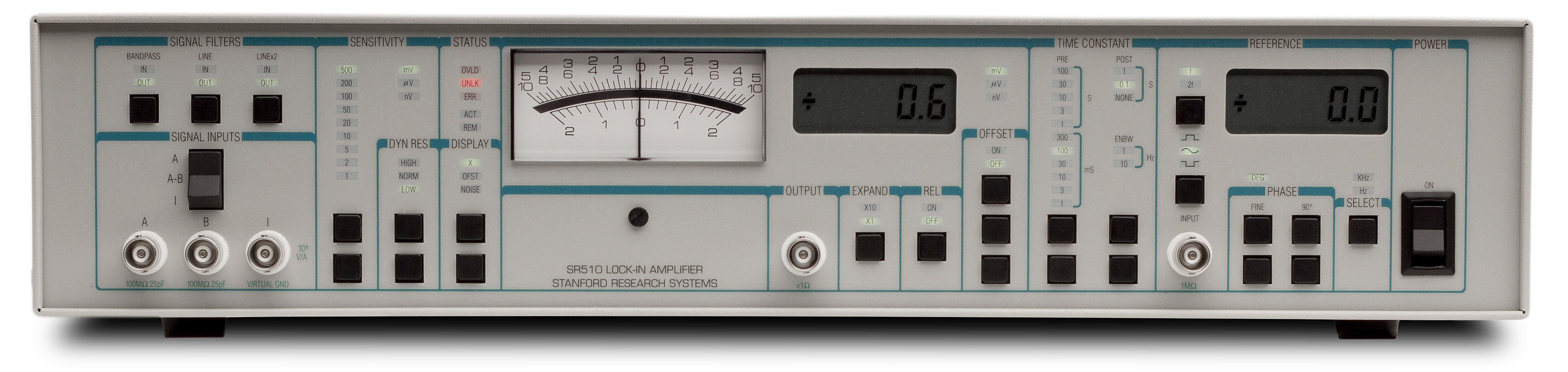
说明
0.5 Hz to 100 kHz frequency range Current and voltage inputs Up to 80 dB dynamic reserve Tracking band-pass & line filters Internal reference oscillator (opt.) Four ADC inputs, two DAC outputs GPIB interface (opt.) 100 kHz frequency range Tracking band-pass filter SR510 Lock-In Amplifier The SR510 is an analog lock-in amplifier which can measure AC signals as small as nanovolts in the presence of much larger noise levels. It has low-noise voltage and current inputs, high dynamic reserve, two stages of time constants, and an internal oscillator. ... click for SR510 Tech Support Lock-In Basics Signal Enhancement SR510 Rack Mount Drawing SR865A Lock-In Amplifier SR830 Lock-In Amplifier Optical Choppers CS580 Current Source DC205 Voltage Source SRS Preamplifiers Lock-In Basics Signal Enhancement SR510 Rack Mount Dwg. SR865A Lock-In Amp. SR830 Lock-In Amp. Optical Chopper CS580 Current Source DC205 Voltage Source SRS Preamplifiers The SR510 is an analog lock-in amplifier which can measure AC signals as small as nanovolts in the presence of much larger noise levels. It has low-noise voltage and current inputs, high dynamic reserve, two stages of time constants, and an internal oscillator. In addition, both lock-ins come equipped with a variety of features designed to make them simple to use. The core of the SR510 is a precision analog sine-wave multiplier . Lock-ins use a multiplier (demodulator) to translate the signal input (at reference frequency) down to DC where it can be filtered and amplified. Many lock-ins use square wave multipliers which introduce spurious harmonic responses. The SR510 usea clean sine-wave multiplier which is inherently free of unwanted harmonics. The SR510 has differential inputs with 7 nV/√Hz of input noise and 100 MΩ input impedance. The input can be configured as a voltage input, or as a current input with 10 6 V/A gain and an input impedance of 1 kΩ to virtual ground. Full-scale sensitivities from 500 mV down to 100 nV are available. Three input prefilters can be selected. The first is a line notch filter providing 50 dB of rejection at the line frequency. The second filter similarly provides 50 dB of rejection at the second harmonic of the line frequency. The third filter is a band pass filter which automatically tracks the reference frequency. These three filters can eliminate much of the noise in the signal before it is amplified. The reference input can be set to lock to sine waves or to either edge of a pulsed reference. The reference frequency range is 0.5 Hz to 100 kHz, and detection at both the fundamental and second harmonic of the reference is allowed. A convenient, built-in frequency meter constantly measures and displays the reference frequency with 4-digit resolution . The reference can be phase shifted with 0.025° resolution from the front panel, or shifted in 90° increments for easy measurement of quadrature signals. Output Time Constants Two stages of filtering follow the phase sensitive detector. Time constants can be chosen as long as 100 seconds for maximum noise reduction, or as short as 1 ms (20 µs with modification) for use in real-time servo loops. The two filter stages allow a rolloff of 6 or 12 dB/octave. The dynamic reserve of a lock-in amplifier at a given full-scale input voltage is the ratio (in dB) of the largest interfering signal to the full-scale input voltage. The largest interfering signal is defined as the amplitude of the largest signal at any frequency that can be applied to the input before the lock-in cannot measure a signal with its specified accuracy. The SR510 has a dynamic reserve of between 20 dB and 60 dB, depending on the sensitivity scale. Selecting the band pass filter adds an additional 20 dB of dynamic reserve, making the maximum dynamic reserve for these lock-ins 80 dB . The SR510's offset and expand feature makes it easy to look at small changes in a large signal. Output offsets of 0 % to 100 % of full scale can be selected manually, or by using auto-offset, which automatically selects an offset equal to the signal value. Once the signal is offset, a 10× expand is available to provide increased resolution when looking at small changes from a nominal value. Analog and Digital Displays Precision analog meters and 4-digit digital displays are standard on both lock-ins . On the SR510, you can select displays of the signal amplitude, the signal offset, or the measured noise. The other digital display on both lock-ins can be configured to show either the reference phase or the reference frequency. The SR510's noise measurement feature lets you directly measure the noise in your signal at the reference frequency. Noise is defined as the rms deviation of the signal from its mean. The SR510 will report the value of the noise in both a 1 Hz and 10 Hz bandwidth around the reference frequency. An internal voltage-controlled oscillator provides both an adjustable-amplitude sine wave output and a synchronous, fixed-amplitude reference output. The sine wave amplitude can be set to 0.01, 0.1, or 1 Vrms, and can drive up to 20 mA. The oscillator frequency is controlled by a rear-panel voltage input and can be adjusted between 1 Hz and 100 kHz. Typically, the sine wave output is used to excite some aspect of an experiment, while the reference output provides a frequency reference to the lock-in . There are four A/Ds and two D/As on the rear panel that provide flexibility in interfacing the SR510 with external signals. These input/output ports measure and supply analog voltages with a range of ±10.24 VDC and a resolution of 2.5 mV. The A/Ds digitize signals at a rate of 1 kHz. The D/A output is ideal for controlling the frequency of the SR510's internal voltage-controlled oscillator . A built-in ratio feature allows the SR510 to calculate the ratio of its output to a signal at one of the A/D ports. This feature is important in servo applications to maintain a constant loop gain, or in experiments that normalize a signal to an intensity level. Available Preamplifiers Although the SR510 is completely self contained and requires no preamplification, sometimes an external preamplifier can be useful. Remote preamplifiers provide gain where it's most important— right at the detector, before the signal-to-noise ratio is permanently degraded by cable noise and pickup. The SR550 FET-input preamplifier, the SR552 bipolar-input preamplifier, and the SR554 transformer-input preamplifier are ideally suited for use with the SR510 lock-in . These preamplifiers are especially useful when measuring extremely low-level signals . An RS-232 computer interface is standard on the SR510. An optional GPIB interface is also available. All features of the instruments can be queried and set via the computer interfaces. SR510 Specifications
相关产品
提交需求
请填写必填信息,我们将在工作日尽快回复。