Low Noise Current Preamplifier - SR570
SR570
5 fA/√Hz input noise 1 MHz maximum bandwidth Adjustable bias voltage Two configurable signal filters Variable input offset current
广西科米瑞实验仪器设备有限公司提供 Stanford Research Systems SR570 产品资料、选型咨询、供货报价和售后服务支持,价格面议。
← 返回产品列表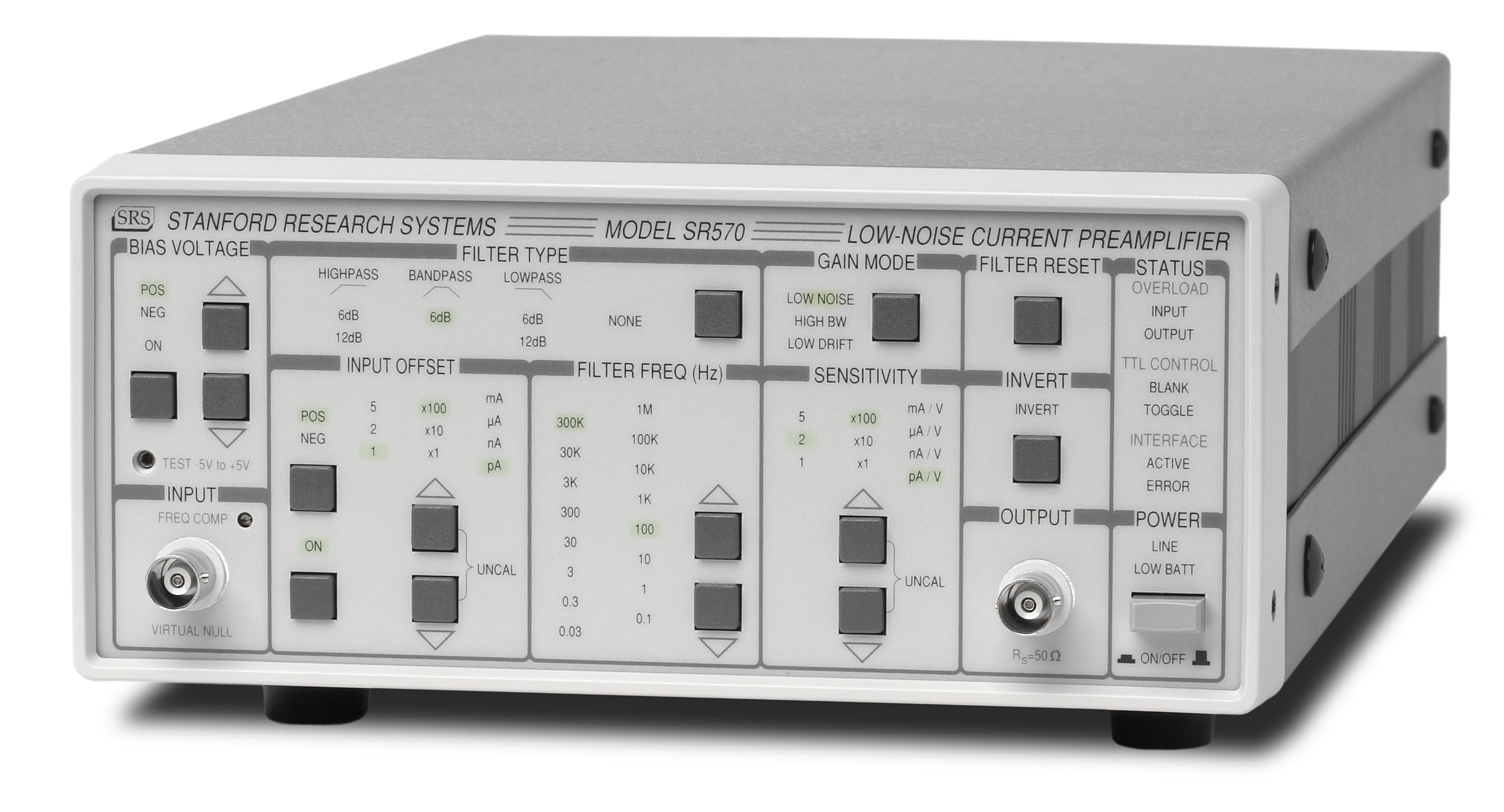
说明
5 fA/√Hz input noise 1 MHz maximum bandwidth Adjustable bias voltage Two configurable signal filters Variable input offset current Line or battery operation SR570 Current Preamplifier The SR570 is a low-noise current preamplifier capable of current gains as large as 1 pA/V. High gain and bandwidth, low noise, and many convenient features make the SR570 ideal for a variety of photonic, low temperature and other measurements. ... click for SR570 Tech Support Single Rack Mount Drawing Double Rack Mount Drawing SR570 Volatility Statement SR570 MSDS Battery Charging Modes SR865A Lock-In Amplifier SR830 Lock-In Amplifier SR2124 Lock-In Amplifier SR860 Lock-In Amplifier Single Rack Mnt. Dwg. Double Rack Mnt. Dwg. SR570 Volatility Statement SR570 MSDS Battery Charging Modes SR865A Lock-In Amp. SR830 Lock-In Amp. SR2124 Lock-In Amp. SR860 Lock-In Amp. The SR570 has sensitivity settings from 1 pA/V to 1 mA/V that can be selected in a 1-2-5 sequence. A vernier gain adjustment is also provided that lets you select any sensitivity in between. Gain can be allocated to various stages of the amplifier to optimize the instruments performance. The low noise mode places gain in the front end of the amplifier for the best noise performance. The high bandwidth mode allocates gain to the later stages of the amplifier to improve the frequency response of the front end. In the low drift mode, the input amplifier is replaced with a very low input-current op amp, reducing the instrument's DC drift by up to a factor 1000. Block Diagram X Block Diagram SR570 Current Preamplifier The SR570 contains two first-order RC filters whose cutoff frequency and type can be configured from the front panel. Together, the filters can be configured as a 6 or 12 dB/oct rolloff low-pass or high-pass filter, or as a 6 dB/oct rolloff band-pass filter. Cutoff frequencies are adjustable from 0.03 Hz to 1 MHz in a 1-3-10 sequence. A filter reset button is included to shorten the overload recovery time of the instrument when long filter time constants are used. Input Offset and DC Bias An input offset-current adjustment is provided to suppress any undesired DC background currents. Offset currents can be specified from ±1 pA to ±1 mA in roughly 0.1 % increments. The SR570 also has an adjustable input DC bias voltage (±5 V) that allows you to directly sink current into a virtual null (analog ground) or a selected DC bias. Two rear-panel, opto-isolated TTL inputs provide additional control of the SR570. A blanking input lets you quickly turn off/on the instrument's gain which is useful in preventing front-end overloading . A toggle input inverts the sign of the gain in response to a TTL signal allowing you to perform synchronous detection with a chopped signal. Three rechargeable lead-acid batteries provide up to 15 hours of battery-powered operation . An internal battery charger automatically charges the batteries when the unit is connected to the line. The charger senses the battery state and adjusts the charging rate accordingly. Two rear-panel LEDs indicate the charge state of the batteries. When the batteries become discharged they are automatically disconnected from the amplifier circuit to avoid battery damage. The microprocessor that runs the SR570 is "asleep" except during the brief interval it takes to change the instrument's setup. This ensures that no digital noise will contaminate low-level analog signals. The RS-232 interface allows listen-only communication with the SR570 at 9600 baud. All functions of the instrument (except power on) can be set via the RS-232 interface . The RS-232 interface electronics are opto-isolated from the amplifier circuitry to provide maximum noise immunity. Low Noise Mode X Low Noise Mode SR570 Current Preamplifier High Bandwidth Mode X High Bandwidth Mode SR570 Current Preamplifier SR570 Specifications Virtual null or user-set bias (±5 V) ±1 pA to ±1 mA adjustable DC offset current 1 pA/V to 1 mA/V in 1-2-5 sequence (vernier adj. in 0.5 % steps) ±0.5 dB to 1 MHz. Adjustable front-panel frequency response compensation for source capacitance. Amplifier ground is fully floating. Amplifier and chassis ground are available at rear panel. Input ground can float up to ±40 V. 2 configurable (low-pass or high-pass) 6 dB/oct rolloff filters. -3 dB points are settable in a 1-3-10 sequence from 0.03 Hz to 1 MHz. Gain is allocated to the front end for best noise performance. Front-end gain is reduced for optimum frequency response. Low bias current amplifier is used for reduced drift at high sensitivity.
相关产品
提交需求
请填写必填信息,我们将在工作日尽快回复。