SR850 - Lock In Amplifier
SR850
0.001 degree phase resolution Time constants from 10 µs to 30 ks (up to 24 dB/oct rolloff) Auto-gain, phase, reserve and offset Data logging (up to 65k samples) Smoothing, curve...
广西科米瑞实验仪器设备有限公司提供 Stanford Research Systems SR850 产品资料、选型咨询、供货报价和售后服务支持,价格面议。
← 返回产品列表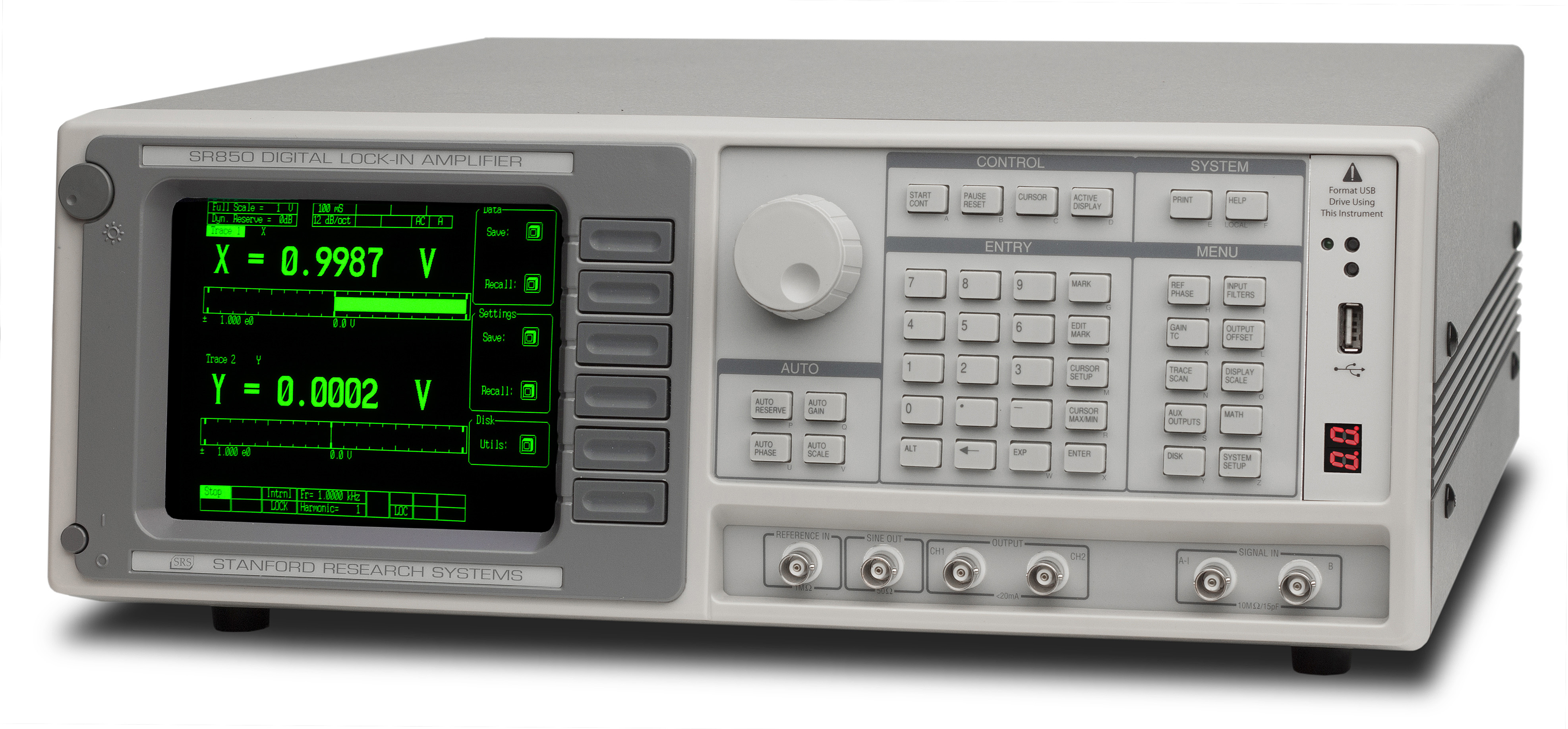
说明
0.001 degree phase resolution Time constants from 10 µs to 30 ks (up to 24 dB/oct rolloff) Auto-gain, phase, reserve and offset Data logging (up to 65k samples) Smoothing, curve fitting & statistics 1 mHz to 102.4 kHz range >100 dB dynamic reserve 10 µs to 30 ks time constants (up to 24 dB/oct rolloff) Data logging (65k samples) Smoothing, curve fitting & stats SR850 Lock-In Amplifier The SR850 is a digital lock-in amplifier based on an innovative DSP (Digital Signal Processing) architecture. The SR850 boasts a number of significant performance advantages over traditional lock-in amplifiers —higher dynamic reserve, lower drift, lower distortion, and dramatically higher phase resolution. ... click for SR850 Tech Support Lock-In Basics Signal Enhancement Rack Mount Kit Drawing SR865A Lock-In Amplifier SR860 Lock-In Amplifier SR830 Lock-In Amplifier SR542 Precision Chopper SR540 Chopper CS580 Current Source DC205 Voltage Source SRS Preamplifiers Lock-In Basics Signal Enhancement Rack Mount Kit Dwg. SR865A Lock-In Amp. SR860 Lock-In Amp. SR830 Lock-In Amp. SR542 Chopper SR540 Chopper CS580 Current Source DC205 Voltage Source SRS Preamplifiers SR850 100 kHz DSP Lock-In Amplifier The SR850 is a digital lock-in amplifier based on an innovative DSP (Digital Signal Processing) architecture. The SR850 boasts a number of significant performance advantages over traditional lock-in amplifiers—higher dynamic reserve, lower drift, lower distortion, and dramatically higher phase resolution. In addition, the flat panel display and 65,536 point memory make it possible to display and process data in a variety of formats unavailable with conventional lock-ins . At the input of the SR850 is a precision 18-bit A/D converter which digitizes the input signal at 256 kHz. The A/D converter, together with a high-speed DSP chip, replace the analog demodulator (mixer), low-pass filters and DC amplifiers found in conventional lock-ins . Instead of using analog components, the SR850 is implemented by a series of precise mathematical calculations which eliminate the drift, offset, nonlinearity and aging inherent in analog components. The same DSP chip digitally synthesizes the reference oscillator, providing a source with less than -80 dBc distortion, 100 mHz frequency resolution, and 2 mV of amplitude resolution. The SR850's display supports a large selection of options. Data can be viewed numerically or graphically in bar graph, polar plot and strip chart formats. With 65,536 points of memory and data acquisition rates up to 512 Hz, you are able to see exactly how your data changes in time—not just what the current output value is. After the data has been acquired, the SR850 offers a variety of data reduction options, such as Savitsky-Golay smoothing, curve-fitting and statistical analysis. Standard RS-232 and GPIB interfaces make it easy to transfer data to your computer. Numeric Readout with Bar Graph X Numeric Readout with Bar Graph SR850 Numeric Readout with Bar Graph The SR850 has a differential input with 6 nV/√Hz input noise. The input impedance is 10 MΩ, and minimum full-scale input voltage sensitivity is 2 nV. The input can also be configured for current measurements with selectable current gains of 10 6 and 10 8 V/A. A line filter (50 Hz or 60 Hz) and a 2× line filter (100 Hz or 120 Hz) are provided to eliminate line related interference. However, unlike conventional lock-in amplifiers, no tracking band-pass filter is needed at the input of the SR850. This filter is used by conventional lock-ins to increase dynamic reserve. Unfortunately, band-pass filters also introduce noise, amplitude and phase error, and drift. The DSP based design of the SR850 has such inherently large dynamic reserve that no tracking band-pass filter is needed. The reference source for the SR850 can be an externally applied sine wave or square wave, or its own digitally synthesized reference source. Because the internal reference source is synthesized from the same digital signal that is used to multiply the input, there is virtually no reference phase noise when using the internal reference. The internal reference can operate at a fixed frequency or can be swept linearly or logarithmically over the entire operating range of 1 mHz to 102.4 kHz. Harmonic detection can be performed at any integer harmonic of the reference frequency—not just the first few harmonics. The DSP approach also offers considerable advantages when working with an external reference. The time to acquire an external reference is only 2 cycles + 5 ms (or 40 ms, whichever is greater)—about ten times faster than conventional lock-ins . Because the SR850 uses a digital phase-shifting technique rather than analog phase-shifters, the reference phase can be adjusted with one millidegree resolution. In addition, the X and Y outputs are orthogonal to within one millidegree. Outputs and Time Constants The output time constants on the SR850 are implemented digitally. Low-pass filter rolloffs of 6, 12, 18 and 24 dB/octave are available with time constants ranging from 10 µs to 30 ks. Below 200 Hz, the SR850 can perform synchronous filtering. Synchronous filters notch out multiples of the reference frequency—an especially useful feature at low frequencies where the proximity of the 2f component would otherwise require a long time constant for effective filtering. The SR850 makes working at low frequencies a far less time consuming task. High Dynamic Reserve The dynamic reserve of a lock-in amplifier at a given full-scale input voltage is the ratio (in dB) of the largest interfering signal to the full-scale input voltage. The largest interfering signal is defined as the amplitude of the largest signal at any frequency that can be applied to the input before the lock-in cannot measure a signal with its specified accuracy. Graphical, Numerical & Bar Graph Displays X Graphical, Numerical & Bar Graph Displays SR850 Graphical, Numerical & Bar Graph Displays The SR850 has the highest dynamic reserve (100 dB) of any lock-in available . In conventional lock-in amplifiers, dynamic reserve is increased at the expense of stability. Because of the digital nature of the filtering and gain process in the SR850, the ultra-high dynamic reserve is obtained without any sacrifice in stability or accuracy. In addition, the SR850's high dynamic reserve is obtained without the use of analog band pass filters, eliminating the noise and error that such filters introduce. Data acquired by the SR850 is stored in up to four user-defined traces . Each trace can be configured as (A×B)/C, where A, B and C are selected from X, Y, R, Θ, noise, frequency or any of the four rear-panel auxiliary inputs. Common operations, such as ratioing, can be performed in real time by defining an appropriate trace. Trace values can be displayed as a bar graph with an associated large numerical display, or as a strip chart showing the trace values as a function of time. Additionally, you can display polar
相关产品
提交需求
请填写必填信息,我们将在工作日尽快回复。